


Robotic Bag and Sack Palletizing
Not sure which model fits?
Send the part weight, the reach you need and the cycle. We will name the model — and say plainly if a robot is not the right answer for it.
Stacking 25 and 50 kg bags by hand is the job most plants automate first. It is heavy, repetitive and the labour turnover is high — and at two or three bags a minute over a full shift, the physical load on an operator is the limiting factor long before the bagging machine is.
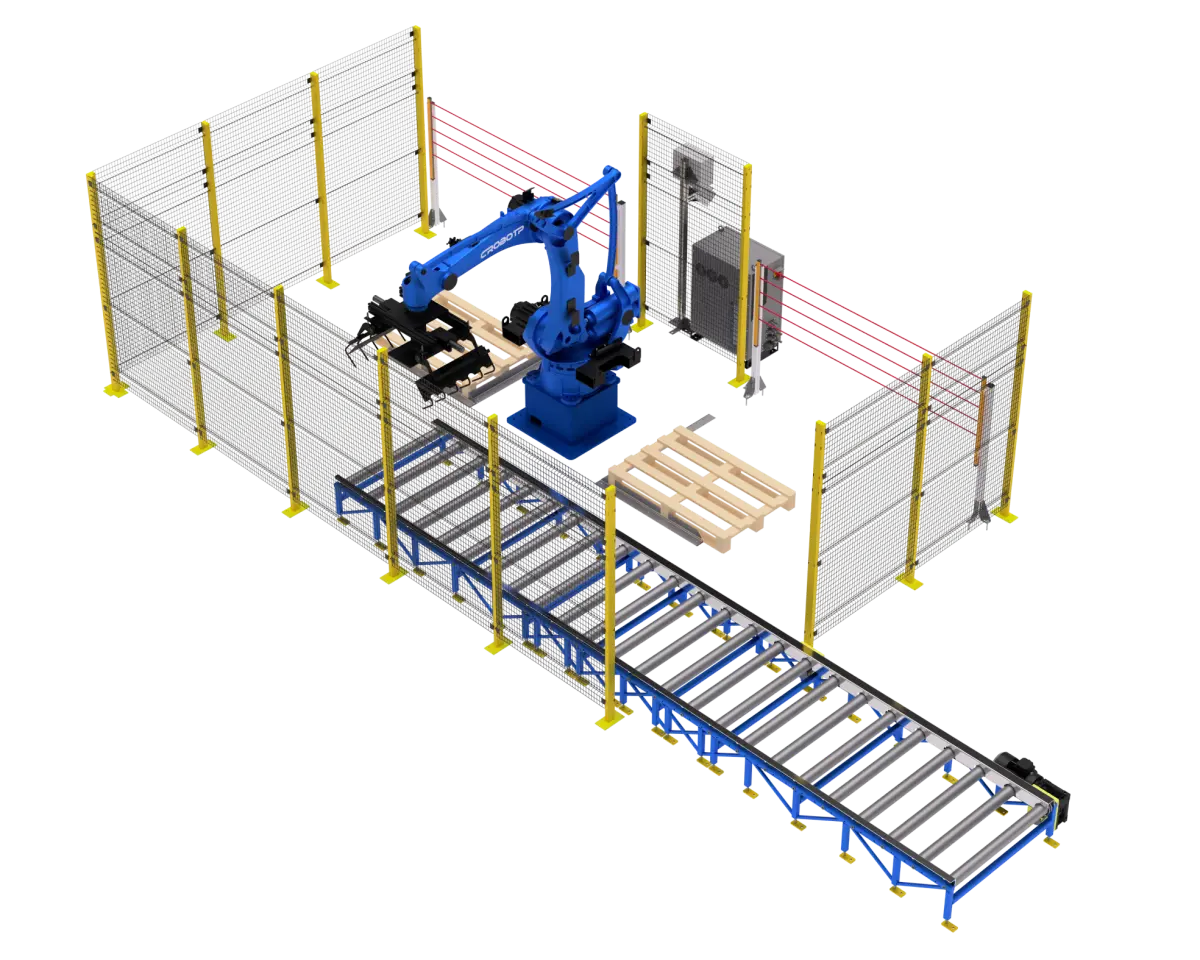
A robot palletizer takes the bag from the discharge conveyor, orients it to the pattern and places it on the pallet. Pattern, layer count and pallet size are parameters, not mechanics: changing from a 5-bag to a 6-bag layer, or from one bag size to another, is a program selection rather than a rebuild. That matters in plants that fill several products on one line.
Which industries use it
Cement and dry mortar, mineral fertiliser, flour and sugar, animal feed, seed, salt, plastic granulate and mining concentrates. Anything filled into a valve or open-mouth bag and stacked on a pallet or slip sheet.
Choosing the robot
Two figures decide it, and both are usually underestimated.
Payload. Size it on the bag plus the gripper, not the bag: the gripper's own mass is part of the payload, and so is a second bag if the gripper picks two at once. Send us the bag weight and the gripper type, and we will size the robot.
Reach. Measure to the top corner of the finished stack, not to the pallet. A 1.8 m column on a 150 mm pallet plus the height of the gripper takes more reach than most first estimates allow.
- RP24-130 — 130 kg, 2485 mm.
- RP32-180 — 180 kg, 3130 mm.
- RP18-25 — 25 kg, 1885 mm.
- RP15-15 — 15 kg, 1530 mm. The manufacturer describes a compact structure and superior waterproof and dustproof performance.
Picking two bags at a time is a gripper option calculated for the specific task: it depends on the bag weight and size, the gripper mass and the required rate. Send us the bag data and the bags per minute, and we will say whether it fits.
All four are four-axis machines. J1–J3 position the arm and J6 turns the product through ±360°; the wrist has no tilt axis. For stacking that is faster than a six-axis arm. Where the bag must be tilted or presented at an angle — some slip-sheet and interlayer operations — a six-axis handling arm such as the RA26-220 or RA28-360 is used instead.
What else the cell needs
The robot is one line item of five. Budget for the bag gripper (clamp, vacuum or fork type, chosen by bag material and whether the bag is deaerated), the infeed conveyor and bag flattener, pallet dispenser and empty-pallet magazine, safety fencing with an interlocked pallet exit, and — where the stack is shipped by road — a stretch wrapper.
Dust is the other design factor. Cement and fertiliser plants need the robot and its cabinet placed and protected accordingly; tell us the product and the fill rate and we will specify it with the factory.
Get a quotation
Send us the bag weight and dimensions, bags per hour, pallet size and stack height, and we will come back with a robot model, a gripper proposal and a price. Drawings are not required at this stage.


