


Robotic Case and Carton Palletizing
Not sure which model fits?
Send the part weight, the reach you need and the cycle. We will name the model — and say plainly if a robot is not the right answer for it.
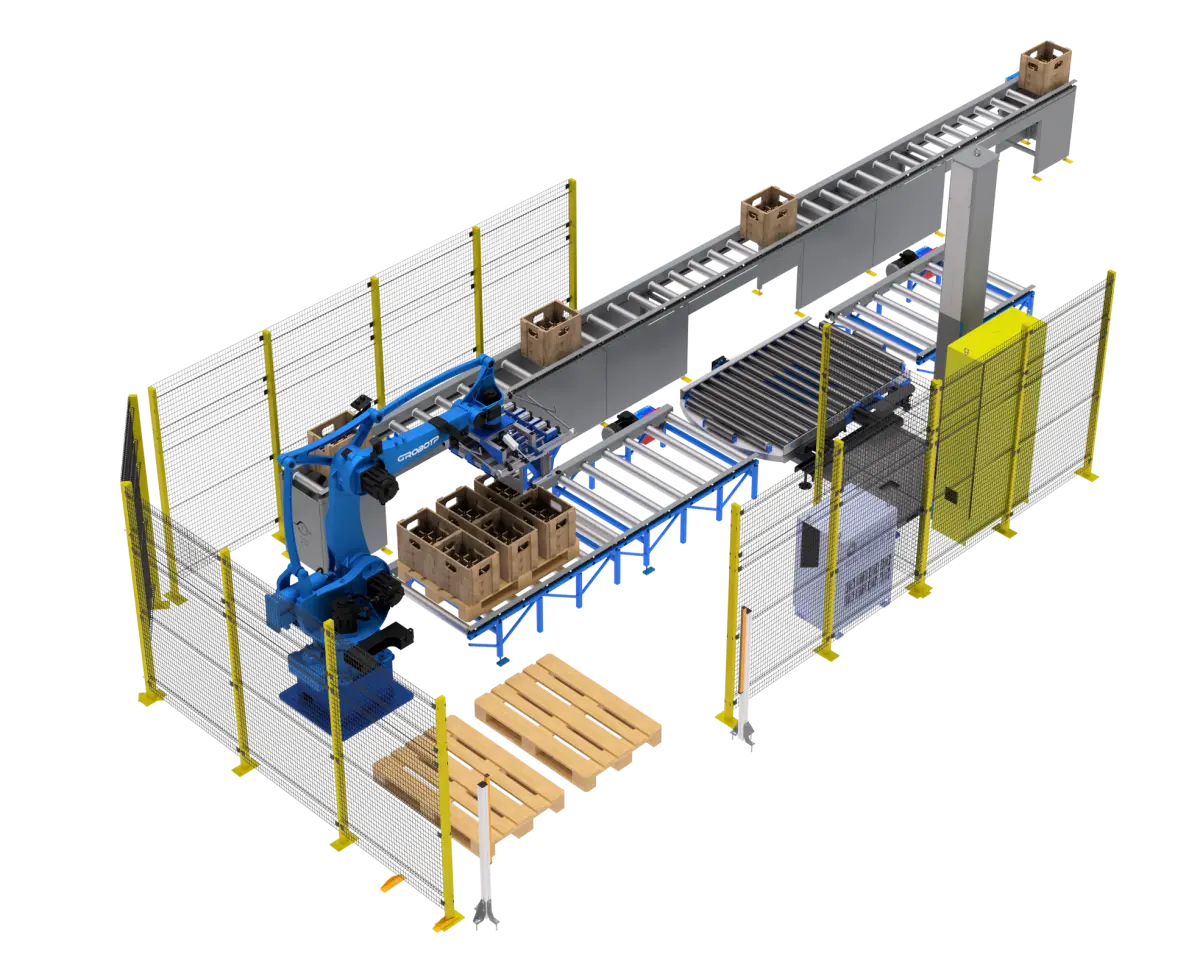
End-of-line palletizing is where most food and beverage plants meet their first robot. The case comes off the packer at a steady rate, the pattern is fixed, the pallet is standard — it is the most predictable job on the line, and the one where manual stacking most often becomes the bottleneck when a line speeds up. A case palletizing robot takes cases, cartons, trays and shrink packs off the end of the packing line and stacks them on the pallet in a programmed pattern.
The argument for a robot over a conventional layer palletizer is changeover. A layer palletizer is faster on one SKU; a robot handles a plant with fifteen SKUs, three case sizes and two pallet formats without mechanical adjustment. Where the product mix changes weekly, the robot wins on availability rather than on speed.
What gets palletized
Corrugated cases, shrink-wrapped multipacks, trays, crates, plastic pails, bottles in shippers, and layer-picked bottles or cans with a full-layer head. Food, beverage, dairy, household chemicals, cosmetics, pharmaceuticals and general packaging lines.
Choosing the robot
Cases are light, so the head, not the case, sets the payload: a two-case head or a full-layer head weighs considerably more than a single-case vacuum or fork head. Rate it on the head plus the maximum simultaneous pick.
- RP18-25 — 25 kg, 1885 mm.
- RP15-15 — 15 kg, 1530 mm. The manufacturer describes a compact structure.
- RP24-130 — 130 kg, 2485 mm.
- RP32-180 — 180 kg, 3130 mm.
Whether several lines can feed one cell, and which gripper fits — single case, multi-case or full layer — depends on the rate of each line and on the pack. Send us the packs per minute on each line and the pack dimensions and weight, and we will size the cell.
Reach again is measured to the top of the finished stack. A 2.0 m beverage pallet plus the head height is beyond what a 1.5 m arm will do, however light the case.
For small packs, trays and cartons at high rate over a short distance, a SCARA robot is faster than a jointed arm — the RS12-60Z40H reaches 1200 mm at 60 kg.
What else the cell needs
Case gripper — vacuum, fork or clamp, chosen by case surface, weight and whether the flaps are sealed — plus a case turning and accumulation conveyor, pallet dispenser, slip-sheet placer where the stack requires it, stretch wrapper, and interlocked fencing with a pallet exit that does not stop the cell.
Cold-store and washdown environments change the specification of both robot and gripper. Say so early; it is not a detail that can be added afterwards.
Get a quotation
Send case dimensions and weight, cases per minute, the pallet pattern and stack height, and the number of SKUs. We will size the robot and the head and quote the cell.


