


Robotic CNC Machine Tending
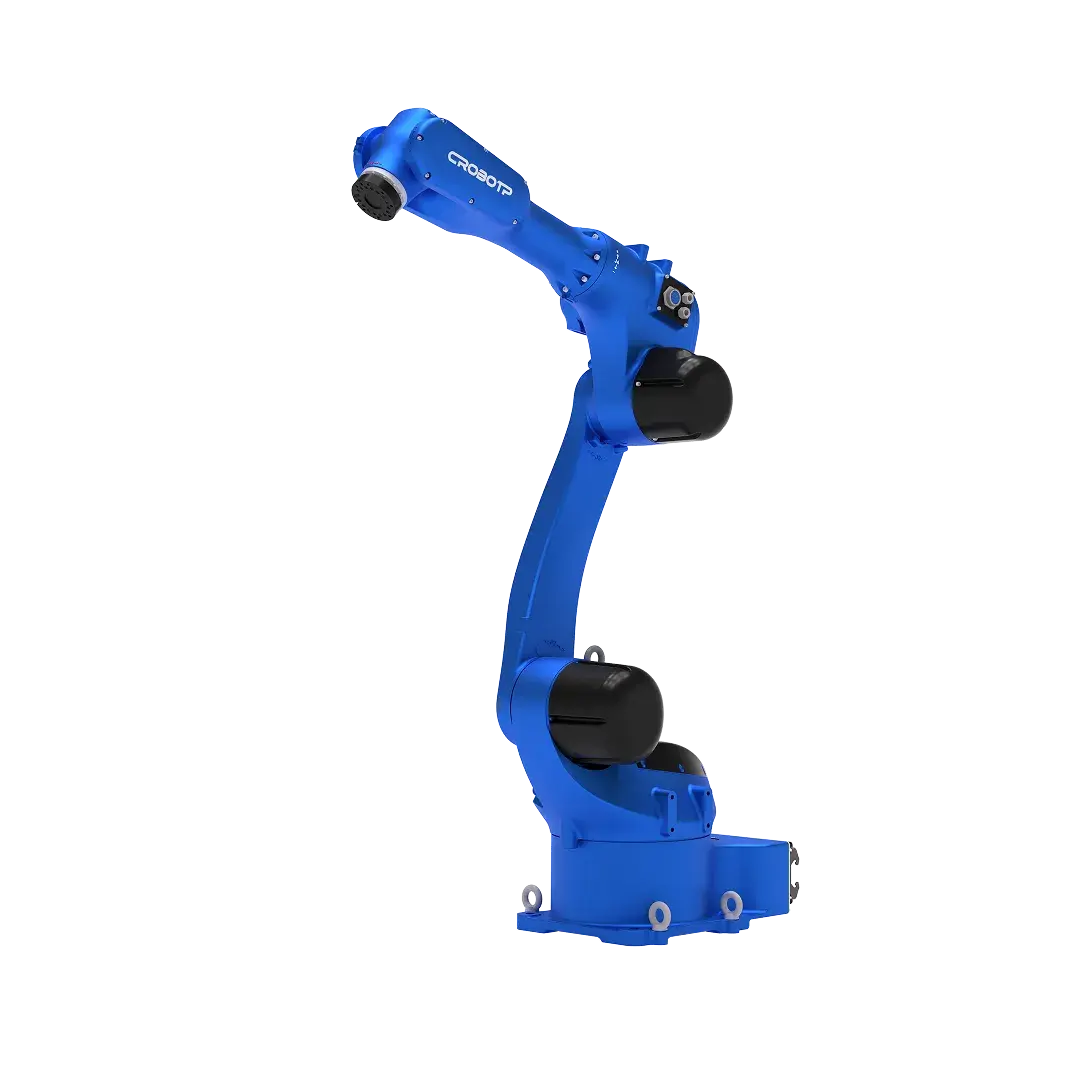
Not sure which model fits?
Send the part weight, the reach you need and the cycle. We will name the model — and say plainly if a robot is not the right answer for it.
A CNC machine earns money while the spindle turns. In most job shops it turns for less than half the shift: the rest is loading, unloading, gauging and waiting for an operator who is running three machines. Automating the load buys spindle hours without buying another machine.
The economics change with lot size. Below roughly fifty pieces, setting up the robot costs more than it saves. Above a few hundred, a tended machine runs through breaks, shift changes and — with an adequate parts buffer — unattended overnight. That last hour is where machine tending usually pays back.
What gets tended
CNC lathes and turning centres, vertical and horizontal machining centres, grinding machines, hydraulic and mechanical presses, injection moulding machines, deburring and washing stations. Whether one robot can serve more than one machine depends on the machining time, the loading cycle and the cell layout: send us the cycle times and the floor plan and we will work it out.
Choosing the robot
Payload is the gripper plus the heaviest raw blank — not the finished part, and not the part alone. A double gripper holds the finished part in one jaw while loading the blank with the other, so unloading and loading are combined in one visit to the machine; its second jaw adds to the mass at the wrist. Allow for it from the start.
Reach decides the cell layout, and specifically how many machines one robot can serve:
- RA15-12 — 12 kg, 1510 mm. One machine plus an infeed table.
- RA20-12 — 12 kg, 2015 mm. Light parts.
- RA18-25 — 25 kg, 1836 mm, and RA18-30 — 30 kg, 1836 mm.
- RA21-50 — 50 kg, 2130 mm.
- RA22-80 — 80 kg, 2200 mm. Heavy blanks.
Six-axis kinematics is what makes tending possible: the gripper enters the machine at an angle, clears the chuck or fixture on the way out, and presents the part to a gauge in a different orientation. A gantry loader does none of that, which is why it only suits machines built around one.
What else the cell needs
Machine interface — the CNC needs an automation package or at minimum M-code handshaking and an automatic door; on older machines this is the item that decides feasibility. Then the gripper (usually double, sometimes with a quick-change coupling for part families), a parts presentation system — pallet, drawer, bin or conveyor, sized for the unattended run length you want — chip and coolant management, and safety fencing with a load station the operator can refill while the cell runs.
Where a machine cannot be interfaced, or where changeovers are frequent and lots are small, a collaborative robot next to the machine is often the more realistic answer.
Get a quotation
Send us the machine make and model, part weight and dimensions, cycle time and lot size. We will tell you whether the machine can be interfaced and what the cell will cost.


