


Robotic Arc Welding of Steel Structures
Not sure which model fits?
Send the part weight, the reach you need and the cycle. We will name the model — and say plainly if a robot is not the right answer for it.
Robotic arc welding pays for itself in two places: consistent penetration on repeated seams, and the ability to weld downhand on parts that a manual welder has to reach around. The second is usually worth more than the first, and it depends less on the robot than on how the part is held.
Manual welding of a fabricated frame is mostly positioning: the welder stops, walks around, re-clamps, and welds the next seam at whatever angle is available. A robot welding the same frame on a positioner welds every seam in the flat position and never stops. Arc-on time in a well-designed cell is several times what a manual station achieves, which is where the payback comes from — not from welding faster.
Which parts suit it
Steel structures and frames, agricultural and construction machinery, trailer and truck bodies, pressure vessels and pipe spools, gearbox and machinery housings, furniture and shopfitting, exhaust and tube assemblies. The common condition is repeatability: the same part more than a few dozen times, with fit-up consistent enough that the seam is where the program expects it.
Choosing the robot
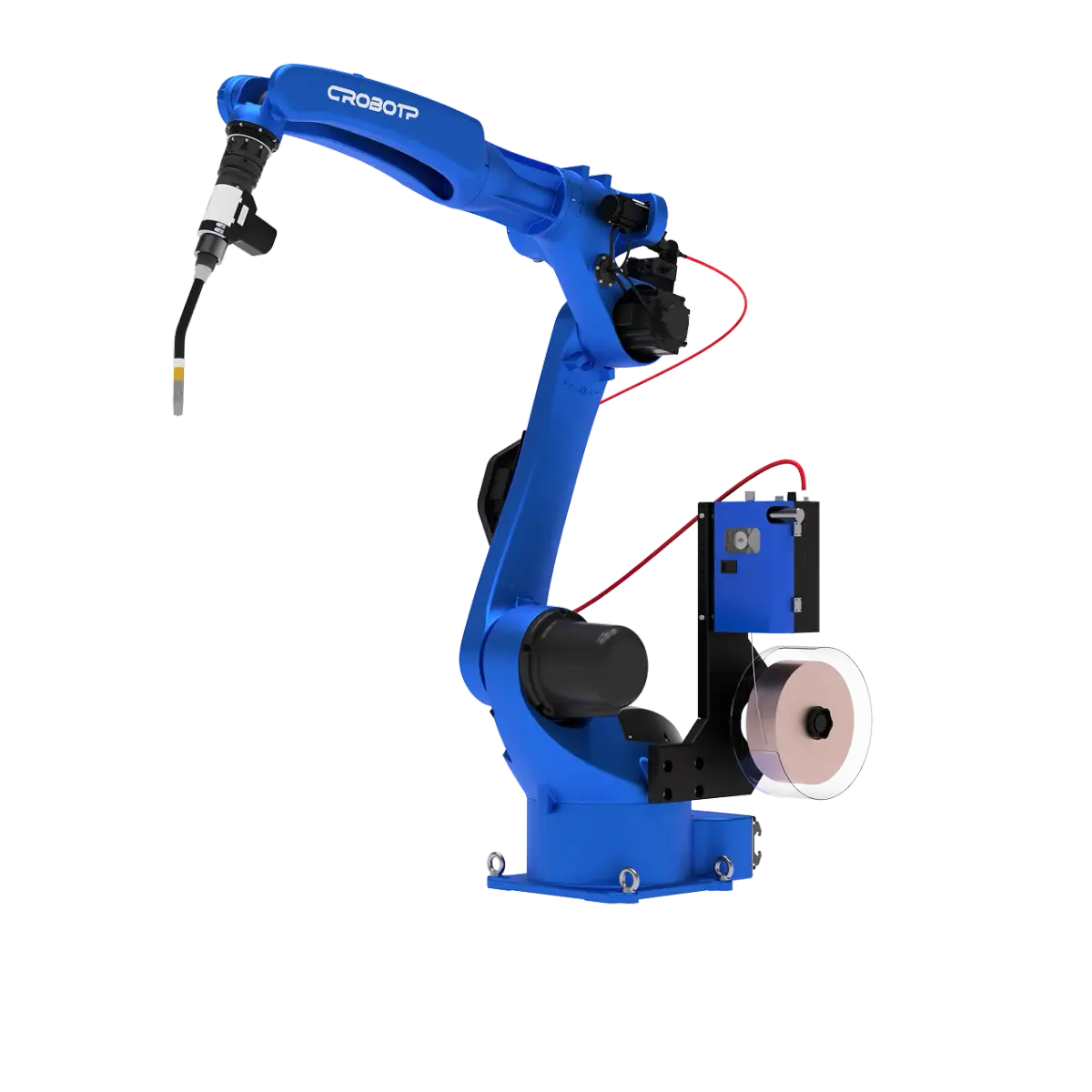
Payload on a welding robot is the torch package, not the part: torch, wire feeder, cable assembly, and any seam-tracking or laser sensor. Weigh the torch package you will use and add any seam-tracking or laser sensor; the lightest welding models carry 6 kg.
- RH14-06-W — 6 kg, 1468 mm, and RH14-10-W — 10 kg, 1440 mm. Small and medium frames, brackets, tube assemblies.
- RH18-06-W — 1850 mm, RH20-06-W — 2012 mm, RH21-06-W — 2093 mm. Larger weldments and parts on a positioner.
- RA32-20-W — 20 kg, 3160 mm. Long structures, chassis and beams.
- The RH14-10-W and RH20-06-W also come in a PRO version: the same robot at a lower price, with a simpler control cabinet. The welding machine is available at 350 A or 500 A. It does the same work as the rest of the series.
The hollow wrist matters more than it sounds. Routing the cable package inside the arm stops it snagging and dragging on long seams and rotating parts, and it is the difference between a cell that runs unattended and one that needs watching.
The positioner decides the cell
Specify the positioner before the robot, not after. It determines what the robot has to reach, and a good positioner frequently allows a smaller arm than the part dimensions suggest.
- Single-axis — one rotation. Right for anything cylindrical or symmetrical: pipe spools, flanges, wheels, shafts, vessel shells. 15 models with rated loads from 150 to 5000 kg across their variants, including movable and idle tailstock versions, roller supports for thin-wall vessels, and a linear track that moves the robot along parts too long to rotate. For the single-axis positioners with a tailstock, with roller supports, of the vertical type and the WB1LC, the manufacturer states accurate rotation and stable fixation of the part for consistent weld quality.
- Two-axis — rotation plus tilt, so seams on several planes all come flat. 8 models, 250 to 2000 kg across their variants. This is the default for frames, brackets and housings. The manufacturer describes its two-axis positioners as used in CRP robotic welding systems for stable weld quality and repeatable positioning.
- Three-axis — three axes; the layout differs by model and is given in the specifications. The WB3CC and WB3SC provide two working zones: loading and unloading in one while the robot continues welding in the other. Whether a three-axis table suits your part, we will say from the drawing and the cycle time. The manufacturer also lists fast part changeover without stopping the robot cycle and higher productivity thanks to a continuous operating cycle.
Size by the part weight together with the fixture.
What else the cell needs
Welding power source and wire feed, fixture and clamping, torch cleaning and wire cutting station, fume extraction, welding screens and interlocked fencing, and — for parts with variable fit-up — seam tracking. Offline programming is worth considering when there are many part variants.
Get a quotation
Send a drawing or photograph of the part with material, thickness, weld lengths and annual volume. We will propose a robot, a positioner and a cell layout.


