


Robotic Deburring, Grinding and Polishing
Not sure which model fits?
Send the part weight, the reach you need and the cycle. We will name the model — and say plainly if a robot is not the right answer for it.
Deburring and finishing is the process most fabricators automate last and regret not automating first. It is dusty, noisy, hard on the operator's hands and lungs, and the result varies with who is doing it — which is exactly the kind of variation a customer notices on a visible surface. A deburring and polishing robot carries a spindle or abrasive tool over the part — or presents the part to a fixed belt or wheel — and repeats the same path on every part.
A robot does not finish better than a good operator. It finishes the same way every time, for a full shift, on a part where consistency is the specification.
What gets processed
Weld bead dressing on visible seams, flash removal from castings and forgings, edge breaking on machined parts, sanding and polishing of stainless steel fittings and sanitary ware, finishing of composite and plastic panels, mould and die polishing, and surface preparation before coating.
Choosing the robot
Material removal is different from handling in one respect that decides the specification: the process pushes back. Cutting forces act on the arm continuously and in directions that change along the path, so structure and repeatability matter more here than raw payload.
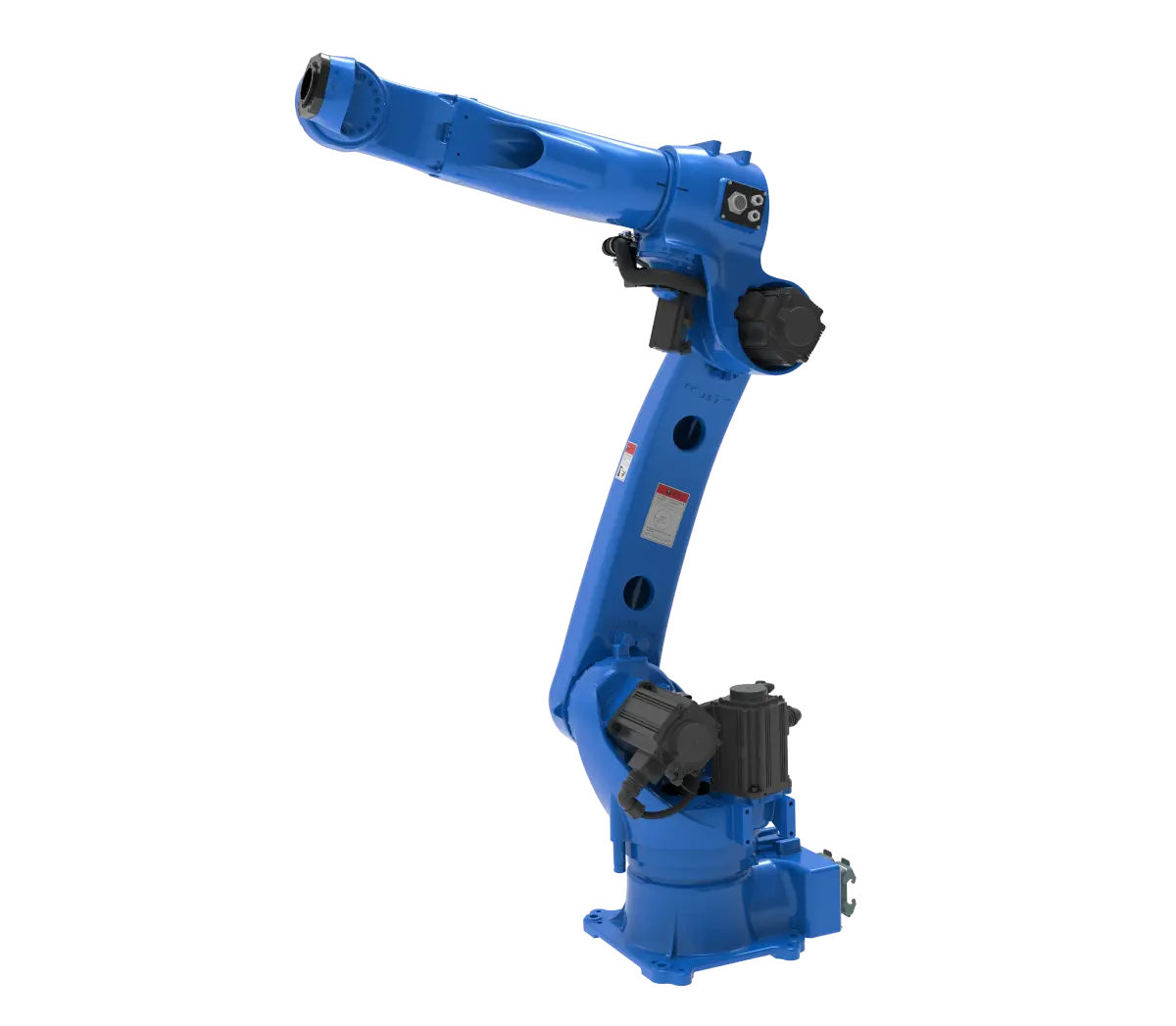
The three CRP models for this work carry the HP designation — Higher Productivity. The factory rates them at 25 to 30 percent shorter cycle times than the standard arms, with a rigid structure, high repeatability and a compact footprint. On finishing work that difference compounds: the same program over a full shift produces measurably more parts.
- RH15-15-HP — 15 kg, 1516 mm. Small parts, hand-tool-sized spindles, benchtop cells.
- RH18-25-HP — 25 kg, 1842 mm. The general-purpose choice, with room for a spindle and force control.
- RH18-35-HP — 35 kg, 1842 mm. Heavier spindles, tool changers, larger abrasive heads.
Payload here is the process package, not the part: spindle or abrasive tool, tool changer, force-control unit and cabling — weigh the actual package before choosing the model. Under-rating the robot is the commonest specification error on finishing cells.
Two ways round the cell
Either the robot carries the tool and moves over a fixtured part, or the robot carries the part and presents it to a fixed belt, brush or wheel. The second is faster for small parts that can be gripped reliably, and it keeps the abrasive dust away from the robot. For large or awkward parts, the tool goes on the robot.
What else the cell needs
Force compliance is not optional on anything with cast tolerance — without it the robot follows the programmed path rather than the actual surface, and removes too much in one place and nothing in another. Then: spindle or abrasive tool with a changer, dust and fume extraction sized for the material, part fixturing, abrasive wear compensation, and enclosure with the appropriate rating. Aluminium and magnesium dust bring their own requirements.
Get a quotation
Send a part drawing or photograph with material, the areas to be processed and annual volume. We will propose a cell layout and tell you honestly whether the part is a good candidate.


